 Johan Persson
cd0b8a11a3
Johan Persson
cd0b8a11a3
Move jest from dependencies to peer dependencies, allowing users to
choose between Jest 29 and Jest 30.

The CLI now detects the Jest version at runtime and uses the
appropriate environment:
- Jest 29: Uses standard jest-environment-jsdom
- Jest 30: Uses a custom environment based on @jest/environment-jsdom-abstract
  with fixes for Web API globals (fetch, streams, Error, etc.)

The cross-fetch polyfill is only injected for Jest 29, as with Jest 30+
our patched Jest environment is used. The network request blocker is made
MSW-compatible by checking if fetch was wrapped before blocking.

Jest 30 (with jsdom v27) fixes `Could not parse CSS stylesheet`
warnings/errors when testing components from @backstage/ui or other
packages using CSS `@layer` declarations.

New peer dependencies (install based on your Jest version):
- jest (required, ^29 or ^30)
- Jest 29 requires: jest-environment-jsdom
- Jest 30 requires: @jest/environment-jsdom-abstract, jsdom

Production code changes for jsdom 27 testability:
- AppIdentityProxy: extract navigateToUrl method for spying
- LiveReloadAddon: export utils.reloadPage for spying
- collect.ts: export internal.resolvePackagePath for mocking

MockFetchApi: evaluate global.fetch at call time instead of construction
time, allowing MSW to patch fetch after MockFetchApi is constructed.

Test adaptations for jsdom 27:
- Use RGB values instead of named colors in CSS assertions
- Update error format expectations (hyphenated type names, SyntaxError
  instead of FetchError for JSON parse errors)
- Simplify URL error assertions for cross-version compatibility
- Fix accessible name whitespace handling for external links
- Use history.replaceState for location mocking (non-configurable)
- Use fireEvent.blur for contentEditable elements
- Move async assertions inside waitFor for race conditions
- Remove Blob.prototype.text polyfill (now native)
- Remove test case using credentials in plugin:// URLs

Test adaptations for Jest 30:
- Replace `expect.objectContaining([...])` with direct array equality
- Replace `expect.objectContaining({ length: N })` with
  `expect.any(Array)` + separate `toHaveLength()` assertions
- Use child process for native Node.js module resolution in
  collect.test.ts to work around Jest 30's resolver behavior
- Update snapshot headers for new Jest format

Also removes the jest-haste-map patch which is no longer needed.

Signed-off-by: Johan Persson <johanopersson@gmail.com>
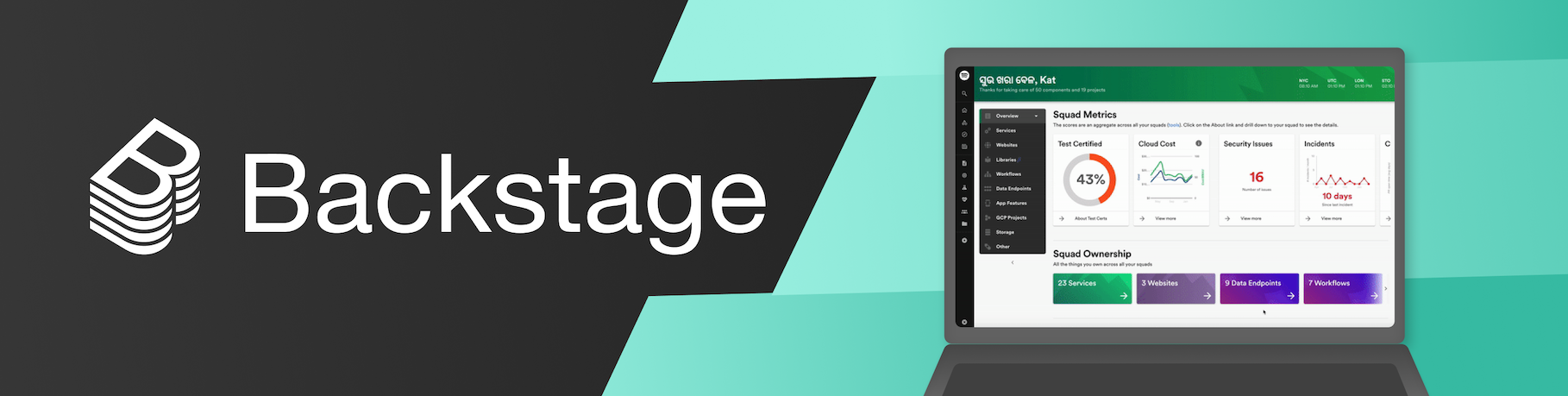
Backstage
English | 한국어 | 中文版 | Français






What is Backstage?
Backstage is an open source framework for building developer portals. Powered by a centralized software catalog, Backstage restores order to your microservices and infrastructure and enables your product teams to ship high-quality code quickly without compromising autonomy.
Backstage unifies all your infrastructure tooling, services, and documentation to create a streamlined development environment from end to end.

Out of the box, Backstage includes:
- Backstage Software Catalog for managing all your software such as microservices, libraries, data pipelines, websites, and ML models
- Backstage Software Templates for quickly spinning up new projects and standardizing your tooling with your organization’s best practices
- Backstage TechDocs for making it easy to create, maintain, find, and use technical documentation, using a "docs like code" approach
- Plus, a growing ecosystem of open source plugins that further expand Backstage’s customizability and functionality
Backstage was created by Spotify but is now hosted by the Cloud Native Computing Foundation (CNCF) as an Incubation level project. For more information, see the announcement.
Project roadmap
For information about the detailed project roadmap including delivered milestones, see the Roadmap.
Getting Started
To start using Backstage, see the Getting Started documentation.
Documentation
The documentation of Backstage includes:
- Main documentation
- Software Catalog
- Architecture (Decisions)
- Designing for Backstage
- Storybook - UI components
Community
To engage with our community, you can use the following resources:
- Discord chatroom - Get support or discuss the project
- Contributing to Backstage - Start here if you want to contribute
- RFCs - Help shape the technical direction
- FAQ - Frequently Asked Questions
- Code of Conduct - This is how we roll
- Adopters - Companies already using Backstage
- Blog - Announcements and updates
- Newsletter - Subscribe to our email newsletter
- Backstage Community Sessions - Join monthly meetups and explore Backstage community
- Give us a star ⭐️ - If you are using Backstage or think it is an interesting project, we would love a star ❤️
Governance
See the GOVERNANCE.md document in the backstage/community repository.
License
Copyright 2020-2025 © The Backstage Authors. All rights reserved. The Linux Foundation has registered trademarks and uses trademarks. For a list of trademarks of The Linux Foundation, please see our Trademark Usage page: https://www.linuxfoundation.org/trademark-usage
Licensed under the Apache License, Version 2.0: http://www.apache.org/licenses/LICENSE-2.0
Security
Please report sensitive security issues using Spotify's bug-bounty program rather than GitHub.
For further details, see our complete security release process.