# Jenkins Plugin (Alpha)
Website: [https://jenkins.io/](https://jenkins.io/)


 ## Setup
1. If you have a standalone app (you didn't clone this repo), then do
```bash
# From your Backstage root directory
cd packages/app
yarn add @backstage/plugin-jenkins
```
2. Add and configure the [jenkins-backend](../jenkins-backend) plugin according to it's instructions
3. Add the `EntityJenkinsContent` extension to the `CI/CD` page and `EntityLatestJenkinsRunCard` to the `overview` page in the app (or wherever you'd prefer):
Note that if you configured a custom JenkinsInfoProvider in step 2, you may need a custom isJenkinsAvailable.
```tsx
// In packages/app/src/components/catalog/EntityPage.tsx
import {
EntityJenkinsContent,
EntityLatestJenkinsRunCard,
isJenkinsAvailable,
} from '@backstage/plugin-jenkins';
// You can add the tab to any number of pages, the service page is shown as an
// example here
const serviceEntityPage = (
{/* ... */}
{/* ... */}
{/* other tabs... */}
{/* ... */}
{/* ... */}
);
```
4. Run app with `yarn start`
5. Add the Jenkins folder annotation to your `catalog-info.yaml`.
Currently, this plugin only supports folders and Git SCM.
Note that if you configured a custom JenkinsInfoProvider in step 2, you may need to use a different annotation scheme here
```yaml
apiVersion: backstage.io/v1alpha1
kind: Component
metadata:
name: 'your-component'
description: 'a description'
annotations:
jenkins.io/github-folder: 'folder-name/project-name'
spec:
type: service
lifecycle: experimental
owner: your-name
```
7. Register your component
8. Click the component in the catalog. You should now see Jenkins builds, and a
last build result for your master build.
## Features
- View all runs inside a folder
- Last build status for specified branch
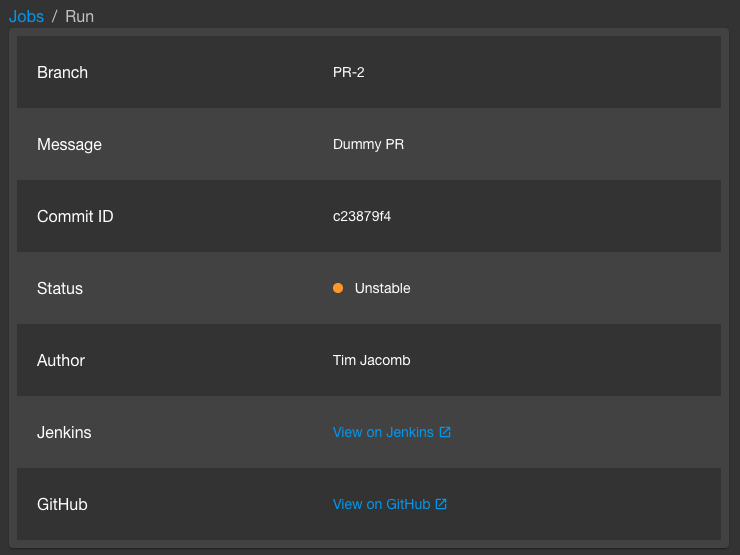
- View summary of a build
## Limitations
- Only works with organization folder projects backed by GitHub
- No pagination support currently, limited to 50 projects - don't run this on a
Jenkins instance with lots of builds
## Setup
1. If you have a standalone app (you didn't clone this repo), then do
```bash
# From your Backstage root directory
cd packages/app
yarn add @backstage/plugin-jenkins
```
2. Add and configure the [jenkins-backend](../jenkins-backend) plugin according to it's instructions
3. Add the `EntityJenkinsContent` extension to the `CI/CD` page and `EntityLatestJenkinsRunCard` to the `overview` page in the app (or wherever you'd prefer):
Note that if you configured a custom JenkinsInfoProvider in step 2, you may need a custom isJenkinsAvailable.
```tsx
// In packages/app/src/components/catalog/EntityPage.tsx
import {
EntityJenkinsContent,
EntityLatestJenkinsRunCard,
isJenkinsAvailable,
} from '@backstage/plugin-jenkins';
// You can add the tab to any number of pages, the service page is shown as an
// example here
const serviceEntityPage = (
{/* ... */}
{/* ... */}
{/* other tabs... */}
{/* ... */}
{/* ... */}
);
```
4. Run app with `yarn start`
5. Add the Jenkins folder annotation to your `catalog-info.yaml`.
Currently, this plugin only supports folders and Git SCM.
Note that if you configured a custom JenkinsInfoProvider in step 2, you may need to use a different annotation scheme here
```yaml
apiVersion: backstage.io/v1alpha1
kind: Component
metadata:
name: 'your-component'
description: 'a description'
annotations:
jenkins.io/github-folder: 'folder-name/project-name'
spec:
type: service
lifecycle: experimental
owner: your-name
```
7. Register your component
8. Click the component in the catalog. You should now see Jenkins builds, and a
last build result for your master build.
## Features
- View all runs inside a folder
- Last build status for specified branch
- View summary of a build
## Limitations
- Only works with organization folder projects backed by GitHub
- No pagination support currently, limited to 50 projects - don't run this on a
Jenkins instance with lots of builds